The true heartbeat of a kitchen isn’t the oven or the fridge, it’s the sink. It’s where every culinary creation begins and ends, and it is the single element that, perhaps more than any other, defines your workspace’s aesthetic and efficiency. In recent years, interior design has seen a massive resurgence of vintage charm, spotlighting two terms often used as synonyms but which actually hide substantial differences: the apron-front sink and the farmhouse sink.
While both evoke a warm, timeless vibe, choosing between them requires a solid understanding of materials, installation requirements, and the visual impact they’ll have on your home. Whether you’re renovating kitchen or starting from scratch, this guide breaks down every detail to help you navigate the styles, benefits, and technicalities.
Definition and origins: More than just a look
To make an informed decision in the “apron-front vs. farmhouse” debate, we first have to clarify the terminology. Much of the confusion comes from the fact that while all farmhouse models feature an exposed front (the “apron”), not every apron-front sink is necessarily “farmhouse” by definition.
What is a farmhouse sink?
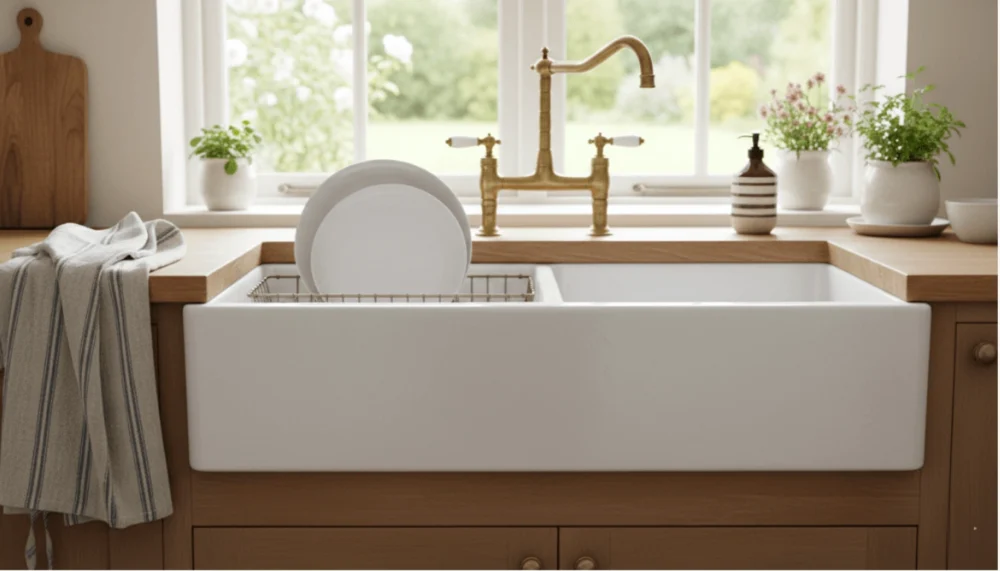
First, let’s answer a fundamental question: what makes a sink “farmhouse”? Historically known as the original farmhouse sink, these basins originated in rural areas before the advent of indoor plumbing. They were engineered to be incredibly deep and spacious, designed not just for washing oversized pots, but for prepping farm-fresh produce or even scrubbing laundry. Their rugged build and classic design remain iconic today, offering an unparalleled sense of warmth and durability.
The apron-front aesthetic
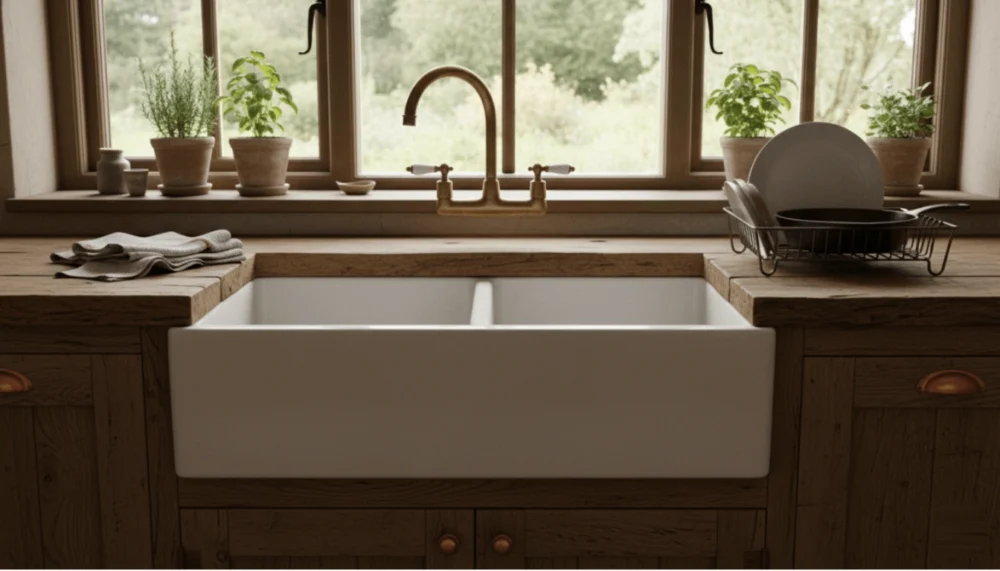
The term apron-front sink refers specifically to the forward-facing part of the basin that remains exposed. Unlike traditional drop-in or undermount models, the “apron” replaces a section of the base cabinet, creating an immediate visual focal point. This design isn’t just about looks, though—it was originally conceived to protect wooden cabinetry from constant moisture while allowing the user to stand closer to the basin without the obstruction of a front countertop edge.
Sink ergonomics and comfort: Why design matters
One of the primary reasons for this style’s enduring popularity is ergonomics. With a traditional sink, the user often has to lean forward to reach over the edge of the countertop. In the case of a farmhouse kitchen sink, the design eliminates this barrier, allowing you to maintain a more upright and comfortable posture.
However, you must pay close attention to the farmhouse sink projection. Since the front panel of a farmhouse overhang sink extends slightly beyond the kitchen cabinets, it is crucial to measure your space accurately to ensure it doesn’t obstruct the opening of adjacent drawers or doors. Furthermore, farmhouse sink dimensions—often looked up as standard farm sink sizes—are generally larger than standard models, we are talking about basins that can exceed 80–90 cm in width and 25 cm in depth, requiring careful planning for both the countertop and the faucet placement.
Contact Us for a Project Consultation
Why pay more? At Georg’s Furniture, we cut out the middlemen to bring you premium furniture, flooring, doors, windows,marble and tiles and more—all at prices up to 40% below retail. With 20+ years of experience and 600 consultants, we provide complete, custom project solutions, from initial design to final delivery.
Comparing materials: From tradition to innovation
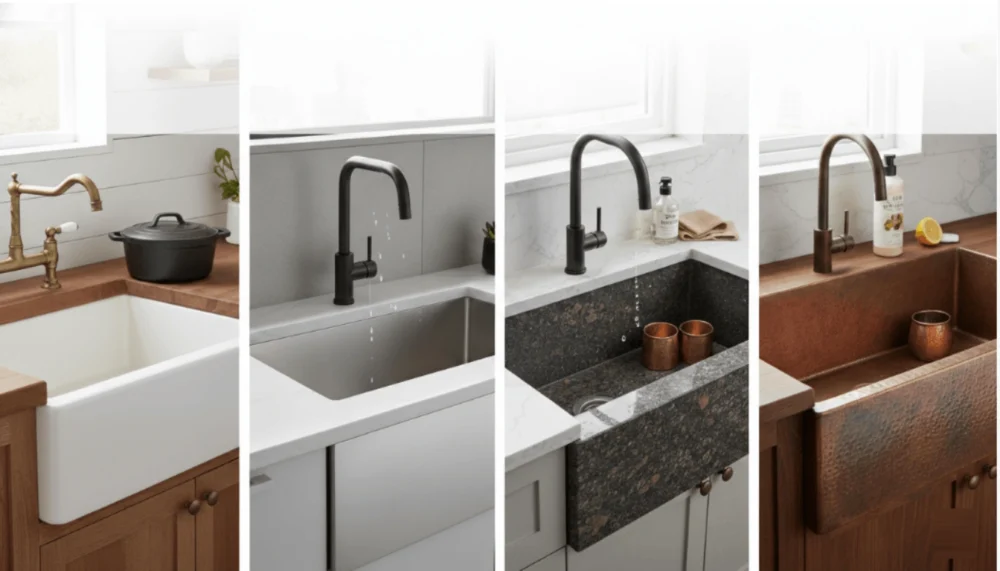
While fireclay remains the gold standard for traditional professional kitchens, many homeowners today are opting for metallic variants. Examining the pros and cons of stainless-steel farmhouse sinks, for example, we see that while they offer unbeatable durability and superior hygiene, perfect for high-traffic kitchens, they can feel aesthetically “colder” than stone and may more easily show limescale spots if not dried carefully.
Ceramic and Fireclay Sinks
This is the quintessential material for the farmhouse look. Fireclay is fired at extremely high temperatures (over 1000°C), making it incredibly hard and resistant to scratches and stains. It’s the perfect choice for anyone seeking that flawless, glossy white finish that screams “cottagecore.”
- Pros:Iconic aesthetic, heat resistant.
- Cons:Can chip if struck hard by heavy cast-iron cookware; extremely heavy.
Stainless Steel Sinks
A modern take on the apron-front design, a stainless steel farmers sink offers a professional, contemporary edge.
- Pros:Lightweight, hygienic, and pairs perfectly with modern appliances.
- Cons:Can be noisy (if not well-insulated) and easily shows water spots and limescale.
Natural Stone Sinks (Granite or Marble)
Carved from a single block of stone, these sinks are essentially functional pieces of art.
- Pros:Unmatched beauty, built to last a lifetime.
- Cons:Requires periodic sealing and comes with a premium price tag.
Copper Sinks
Ideal for those who love a rustic vibe with a touch of metallic warmth. Copper develops a unique “patina” over time, evolving in color and character.
- Pros:Natural antibacterial properties, one-of-a-kind look.
- Cons:Requires specific maintenance to prevent uneven spotting.
Comparison table of materials
Material | Durability | Maintenance | Ideal Style | Cost |
Fireclay | High (but prone to impact chipping) | Easy | Rustic / Shabby Chic | Medium |
Stainless Steel | Very High | Moderate | Modern / Industrial | Medium |
Copper | High | Demanding (patina) | Vintage / Mediterranean | High |
Stone | Excellent | High (sealing required) | Luxurious / Classic | Very High |
Composite | High | Easy | Versatile | Medium |
Contact Us for a Project Consultation
Why pay more? At Georg’s Furniture, we cut out the middlemen to bring you premium furniture, flooring, doors, windows,marble and tiles and more—all at prices up to 40% below retail. With 20+ years of experience and 600 consultants, we provide complete, custom project solutions, from initial design to final delivery.
Technical considerations: Installation isn’t for everyone
Deciding between an apron-front vs. farmhouse sink also involves evaluating the complexity of the assembly. There are several critical factors to keep in mind:
- Due to their depth and material, a farmhouse kitchen sinkcan be extremely heavy. The base cabinet must be reinforced to support the combined weight of the basin, water, and dishes.
- Installation requires a custom cut of the countertop. Once you commit to an apron-front sink, the modification to the top is permanent: switching back to a standard drop-in model would require replacing the entire counter.
- A farmhouse sinkcan weigh anywhere from 40 to 90 kg (not including water). The cabinet below must be structurally reinforced with extra wooden supports. Additionally, the cabinet itself must be custom-cut to accommodate the apron profile.
- Because the sink sits “inside” the counter, the countertop cut must be extremely precise. Any measurement errors could leave unsightly gaps or lead to water seepage.
- Many apron-front sinks do not come with pre-drilled faucet holes. This means the faucet hardware will need to be installed directly into the countertop behind the sink or, in some cases, mounted to the wall.
Pros and cons: An overview
Before pulling the trigger on a farmhouse kitchen sink (or apron-front), it is essential to carefully weigh the pros and cons of such a bold stylistic choice. Among the primary benefits, the visual impact is undoubtedly the standout; this type of sink instantly becomes the room’s focal point. It also offers immense capacity, with a deep basin that makes washing baking sheets, grill grates, and oversized pots a breeze. Furthermore, a wide range of customization options, from rounded edges to aprons decorated with embossed motifs, allows it to fit any aesthetic taste.
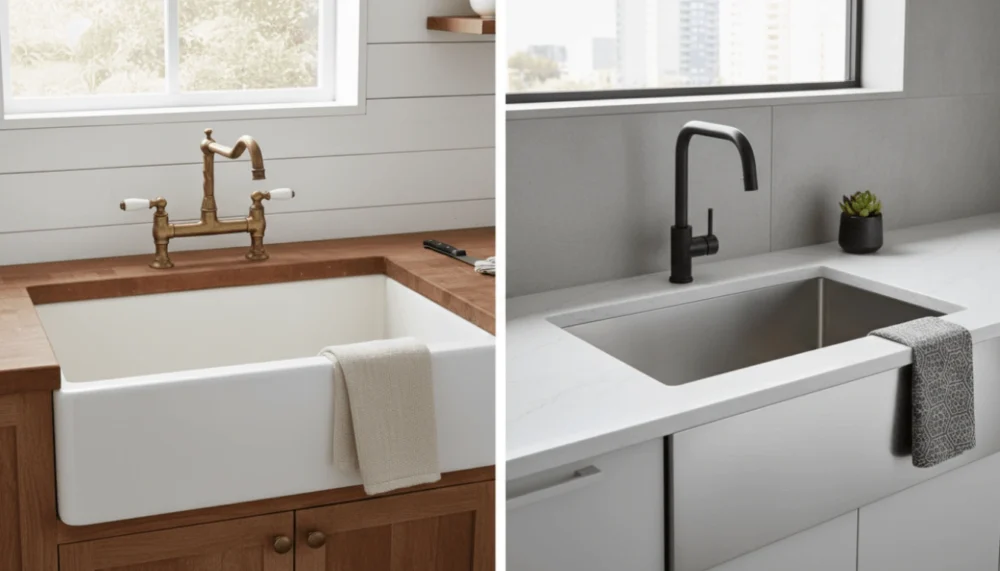
On the flip side, you must consider that the price point is generally higher than standard models, both for the initial purchase and the professional installation. It is also a permanent commitment: once the cabinets and countertops have been modified to house an apron-front model, returning to a traditional solution would almost certainly require replacing the entire kitchen worktop. Finally, keep in mind the risk of water splashing onto your clothes during heavy use, due to how close you stand to the edge.
Installation, costs, and kitchen renovation planning
Installing a projecting sink often requires modifications to the base cabinets and structural reinforcement for heavier models.
Are you doing a full kitchen renovation or just replacing the sink? If it’s a full remodel, integrate your choice early into the design. When calculating the costs for a 10×10 kitchen renovation, be sure to factor this in as well.
Comparison Table
Feature | Apron-front Sink | Farmhouse Kitchen Sink | |
Installation | Moderate difficulty | More complex due to projection | |
Average Cost | €400 – €1200 | €500 – €2000+ | |
Daily Maintenance | Variable | Material dependent | |
Ergonomics | Excellent | Excellent (if sized correctly) | |
Capacity | Good | Generally superior | |
Contact Us for a Project Consultation
Why pay more? At Georg’s Furniture, we cut out the middlemen to bring you premium furniture, flooring, doors, windows,marble and tiles and more—all at prices up to 40% below retail. With 20+ years of experience and 600 consultants, we provide complete, custom project solutions, from initial design to final delivery.
For long-term care, many users choose to invest in stainless steel bottom grids to protect ceramic from accidental impact from pots and pans. This step is highly recommended to preserve the product’s integrity over time and represents a smart investment to significantly extend the life of your sink.
Table: Pros and Cons by User Profile
User Profile | Recommended Sink Type | Reasoning |
Large Family | Fireclay Farmhouse (Single Basin) | Maximum capacity for large pots and stain resistance. |
Single / Tech Couple | Stainless Steel Apron-Front | Easy to clean, minimalist look, pairs well with smart home tech. |
Historic Restoration | Stone or Copper Farmhouse | Historically accurate to period architecture. |
Budget-Conscious | Composite Apron-Front | Stone-like aesthetic at a lower cost and easy to maintain. |
FAQ
Q1. Can I install a farmhouse sink in an existing kitchen?
It’s difficult. Farmhouse sink dimensions often require structural modifications or the complete replacement of the sink base cabinet. We recommend planning the installation during a full renovation to ensure the cabinet is properly reinforced and sized for the new basin.
Q2. How far should the apron project from the front?
The ideal farmhouse sink projection is approximately 2–3 cm. This measurement ensures that water drips onto the floor rather than the cabinetry, while maintaining a balanced aesthetic and providing enough ergonomic clearance for your legs while working.
Q3. What is the most durable material for an apron-front sink?
When analyzing the pros and cons of stainless-steel farmhouse sinks, steel comes out on top for impact resistance. However, fireclay is superior in terms of scratch and extreme heat resistance, making both materials excellent choices depending on your specific priorities.
Q4. What exactly is meant by a “farmhouse sink”?
In technical terms, the answer to “what is a farmhouse sink?” is a deep, single-basin lavatory historically used in rural settings. It is characterized by its high-volume capacity and a rugged build designed for heavy-duty, long-lasting domestic tasks.
Apron-front vs. farmhouse sinks: Which is right for you?
In conclusion, deciding between an apron-front or farmhouse sink means balancing your aesthetic desires with the practical demands of modern life. Both models offer timeless charm and superior ergonomics that can radically transform your kitchen experience. Choosing a high-quality farmhouse kitchen sink is a labor of love for your home, an investment that adds value and daily beauty. George’s Furniture is ready to support you with professional furnishing solutions, ensuring every detail, from farmhouse sink dimensions to cabinet durability, is absolutely perfect.